
Reviewed · AMSTERDAM WALKING TOURS
Walking Tour about Golden Age Architecture, private local guide
Golden Age architecture in Amsterdam is interesting because it is not just pretty buildings. It is a record of how a trading powerhouse built, financed, and engineered its way through soft ground and fast-changing wealth. I love the way this tour connects what you see on the street to the ideas behind it, and I also like that it is a private local guide experience just for your group.
My second favorite part is the close reading. You stop at canal houses, mercantile façades, and the small details like gevelstenen that many people walk past. One drawback to plan for: this walk is about 1.5 hours and it is not recommended if you use a walker or have trouble walking and standing for that long, and mobility aids are not available.
Key Things You Should Know Before You Go
- Private for your group: It is a true private tour, so you can ask questions at each stop.
- Golden Age, with engineering stories: You get explanations beyond style, including building challenges on clay and marshy ground.
- Canal-belt highlights in one route: You see major landmarks plus the Jordaan side of the story without needing multiple tickets.
- Facade stones and crooked houses: These are the details that make Amsterdam feel personal, not postcard-perfect.
- Great English delivery: The tour is offered in English, and the guide approach is described as friendly and patient.
Why Golden Age Architecture Is the Perfect Amsterdam First Walk
Amsterdam’s Golden Age look is easy to spot once someone teaches you what to notice. You see it in the canal belt homes, the merchant-class façades, and the way the city handled water and unstable ground. What makes this walk especially useful is the “why” behind the “wow.”
I love that you are not stuck with general talking points. You get guided stops where each building becomes a clue, from civic power to private wealth to working trade. If you want your first Amsterdam days to feel organized and meaningful, this is a smart place to start.
More walking tours in Amsterdam:
- Anne Frank’s Story – Guided Walking Tour through Amsterdam
★ 5.0 · 11,619 reviews - Amsterdam: Life of Anne Frank and World War II Walking Tour
★ 4.8 · 10,467 reviews - Absolutely Amsterdam – the Essential Introductory Walking Tour
★ 5.0 · 3,629 reviews
Price, Timing, and What You Actually Get for 1.5 Hours
At $73.59 per person for about 1 hour 30 minutes, you are paying for a guided route plus interpretation. In Amsterdam, a private guide can be pricey, so the value comes from how much you cover and how focused the stops are.
This tour is booked an average of 43 days in advance, which is a quiet sign that it gets popular. If you care about your schedule, book early, then build the rest of your day around an easy walk.
You also get a mobile ticket, and admissions on the stops are marked free. That is not just convenient, it helps you keep momentum, because you are spending time looking instead of managing ticket lines.
Start at Dam Square: From Public Power to Urban Ambition
Your walk begins at Dam Square, and the start matters. Dam Square is where Amsterdam shows off its civic identity, so it is the right place to talk about how the city rose in the 17th century as a global trade hub.
This first stretch is about setting context fast. You learn what the Golden Age meant for the city’s architecture and cultural legacy, so the buildings you see later do not feel random. You are basically getting your street-level cheat sheet before the details start.
Royal Palace Amsterdam: Town Hall Roots and Neoclassical Craft
Next up is the Royal Palace of Amsterdam, and it is a great stop because it changes roles over time. Originally built as the city’s town hall during the Dutch Golden Age, it became a royal residence later. That shift explains why the building feels both official and monumental.
You also get an architectural style lesson. The palace is described as Dutch Neoclassical, and the guide talks about materials and techniques used to create the grand structure.
Then comes the engineering piece people often miss, building on challenging clay and marshy ground. When you hear that, you start noticing the city differently. Amsterdam is not just built on land, it is built on problem-solving.
A few more Amsterdam tours worth comparing
- Amsterdam: 75 Minute City Canal Cruise with Audio Guide
★ 4.4 · 17,501 reviews - Amsterdam: Johan Cruijff ArenA Tour with Optional Guide
★ 4.6 · 8,954 reviews - Amsterdam: Royal Palace Entry Ticket and Audio Guide
★ 4.6 · 6,475 reviews - Amsterdam: Guided Zaanse Schans, Windmills & Cheese Tour
★ 4.4 · 4,826 reviews
Huis Bartolotti: Red Brick Baroque and Trade Connections to Italy
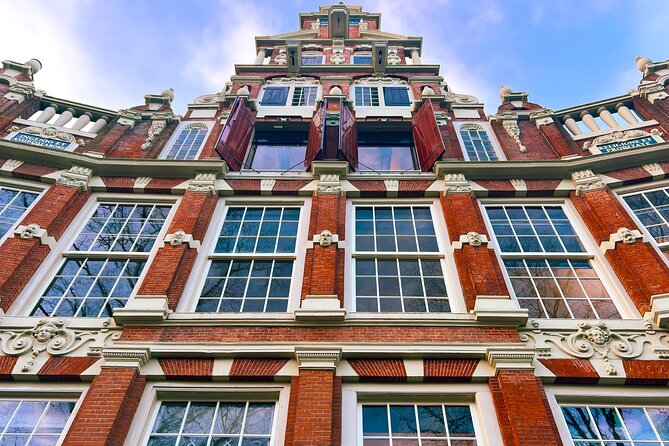
House Bartolotti is a strong mid-tour anchor because it looks like wealth, not just function. Along a scenic canal, it is presented as a 17th-century Dutch baroque example with striking red brick and large windows.
You will also learn where some of the detail comes from. The façade includes intricate sculptural elements made of sandstone, which adds texture to the street view. And the guide connects the ornate design to the owner’s status and trading ties with Italy.
Even if you are not a baroque fan, this stop helps you understand why canal houses feel theatrical. The architecture was a social statement, not just a house plan.
Torensluis and the Crooked Houses: How Soft Ground Writes Architecture
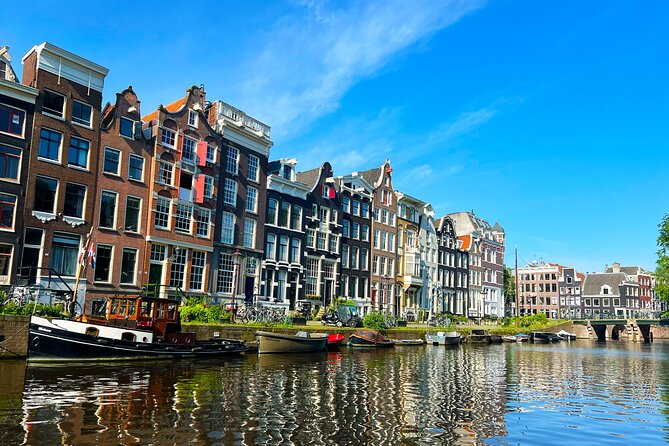
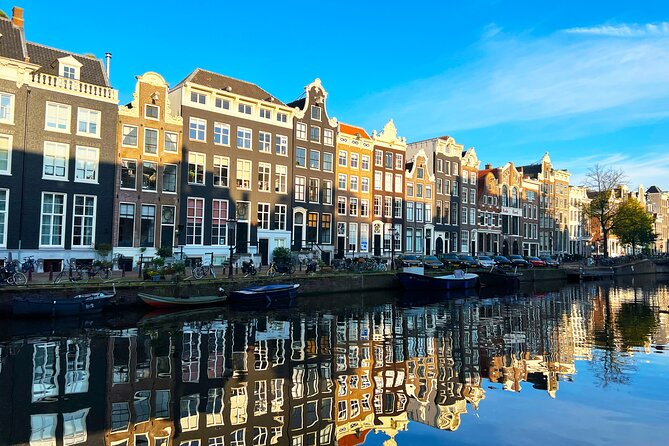
At Torensluis, the bridge viewpoint is doing double work. You get a perfect look at four unique façade designs tied to the mercantile class of the Golden Age, and you see how baroque styling got adapted in the Netherlands.
Then you get one of Amsterdam’s most memorable quirks: the crooked houses. The tour frames it as a result of Amsterdam’s soft, marshy ground, which helps explain why some buildings lean in unusual, almost whimsical ways.
This is a good pause for photos, but also a good pause for perspective. Amsterdam’s charm is not only symmetry and polish. It is also the visible evidence of how the city grew under difficult conditions.
De Dolphijn: The Dolphin Symbol, Maritime Wealth, and Rembrandt’s Link
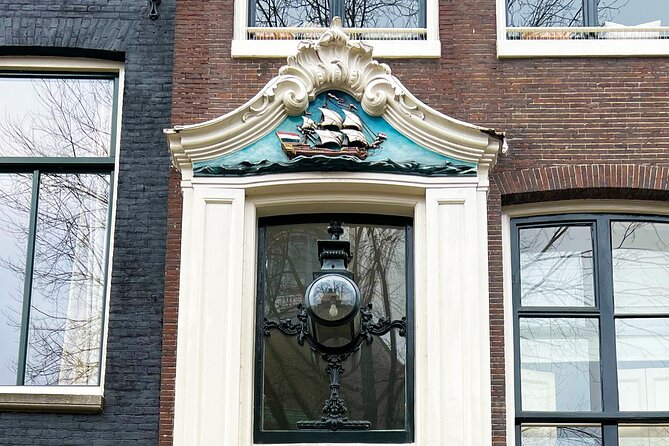
De Dolphijn is named for the dolphin symbol of wealth, tied to Amsterdam’s maritime trade during the Dutch Golden Age. That is a fun connection because it turns a simple street stop into a story about how commerce became imagery.
You will also hear about Frans Banning Cocq, the captain immortalized in The Night Watch. The tour connects him to the house, so the building becomes more than architecture. It becomes a physical link between the city and one of the most famous paintings in Dutch art.
The takeaway here is how canal-belt identity worked. Many houses carried symbols and status markers, so even from the street you are reading the city’s economic self-image.
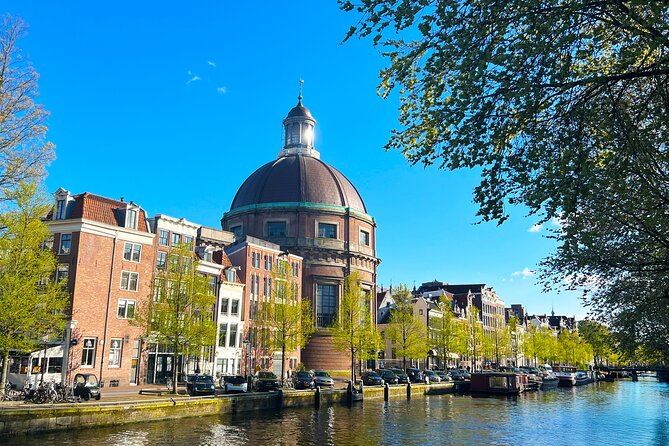
Ronde Lutherse Kerk: A Quick Stop That Teaches You How Styles Shift
The walk continues to Ronde Lutherse Kerk, and this stop is brief on purpose. The tour uses it to talk about domes as a high point of architectural achievement during the Renaissance period.
You might not get a long museum-style explanation here, but you do get something useful. It is a style stepping stone, helping you place what you are seeing on a timeline, not just as separate buildings.
If you like architecture as a sequence of ideas, this quick stop adds clarity without slowing the route.
Prinsengracht Warehouses: Where Trade Needed Hoisting Beams and Tall Gables
Prinsengracht is where the tour shifts into working architecture, and that is a big part of the appeal. Along Prinsengracht, you see warehouses designed for trade and commerce in the 17th century.
The key details are practical. The buildings are described as having tall, steeply pitched gables, large windows, and wooden hoisting beams on the roof. Those beams were used to lift heavy cargo from ships docked along the canal.
What I like here is the balance between function and form. The exteriors have clean lines and minimal ornamentation because they were meant to do a job. At the same time, the grand scale shows the wealth of the merchants who funded the trade.
If you want to understand why Amsterdam’s canal belt is so distinctive, this is the stop that makes it make sense.
Jordaan and Gevelstenen: Reading the Facades Like a Local
Jordaan gets attention for a reason. In the 17th century it was described as a mix of residential and commercial life, starting as a lower- and middle-class district for craftsmen and laborers. Over time, it became busy with narrow canals and rows of houses, with small shops or workshops on the ground floors.
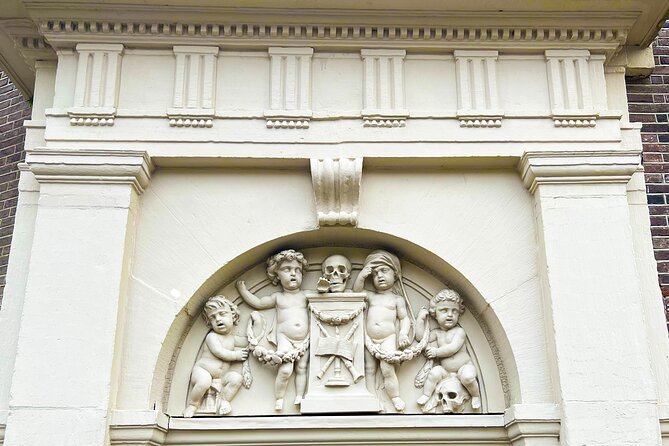
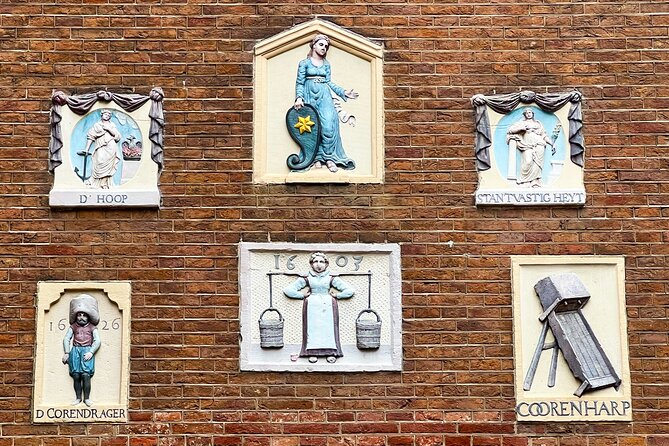
The tour focus here is on gevelstenen, or facade stones. These small decorative plaques embedded in façades function as more than decoration. They communicate building use, professions of owners, or other facts about people living and working there.
What makes this stop special is how it changes your walking habit. Instead of only looking at big façades, you learn to scan for small clues. You start noticing how Amsterdam turns everyday life into readable street signals.
Westerkerk and the 85 Meter Spire: Calvinist Simplicity Meets Landmark Power
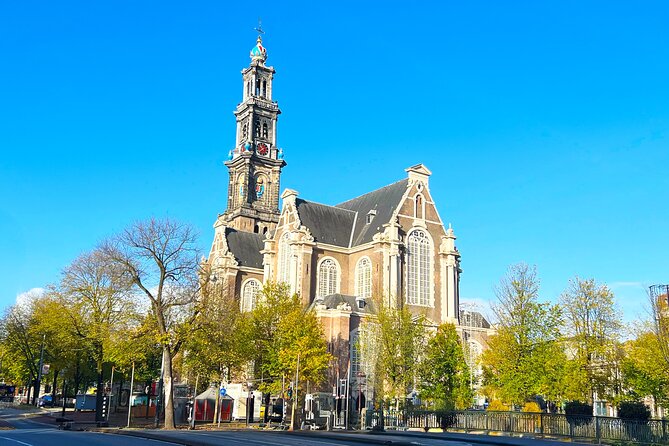
The end stretch takes you to Westerkerk, one of Amsterdam’s important landmarks. It began as a Calvinist church for a growing city population, and the tour frames the style as simple and elegant, with a large airy interior.
You will also hear a memorable historical link. Westerkerk is described as the final resting place of Rembrandt van Rijn.
The tower is the visual finish. The spire reaches 85 meters, completed in 1638, and it is crowned with an imperial crown linked to Amsterdam’s status since the 15th century. There is also a clock with distinctive chimes, and the tour notes that Anne Frank mentioned the chimes in her diary.
The route ends near Westerkerk, close to the famous Anne Frank House area, so if you have that on your list, the timing can work nicely.
What to Bring, Where to Pause, and How to Get the Most Out of It
Bring comfortable walking shoes. The tour is not built for long stops at one location, so you want your feet to cooperate during the full 1.5 hours.
If you care about photos, this is the kind of tour where you can ask for a moment. The guide approach described in the experience notes emphasizes being patient and allowing time for questions and photos.
Also, plan for the simple truth: the tour does not include bottled water. Amsterdam is often walkable, so you might want to buy a bottle nearby before the start if you get thirsty easily.
Who This Private Golden Age Walk Fits Best
This tour is a strong fit if you:
- Want a focused introduction to Amsterdam’s 17th-century architecture without piecing together multiple stops yourself
- Like asking questions and getting answers tied to specific buildings
- Enjoy seeing how wealth, trade, and engineering shaped street-level design
It is also a great option if you are the kind of person who looks at canals and thinks, What am I actually seeing here? This tour gives you the vocabulary, then points you to the evidence.
It may be less suitable if you:
- Use a walker
- Have difficulty walking and standing for 1.5 hours
- Need mobility aids, because the tour does not provide them
Should You Book This Golden Age Architecture Walk?
If you want Amsterdam that feels explained, I think you should book this. The route hits high-value stops, from Dam Square and the Royal Palace to canal houses, warehouse architecture on Prinsengracht, and Westerkerk. You come away with a clearer sense of how Golden Age trade turned into design choices, and you learn details like the reasoning behind crooked houses and the purpose of wooden hoisting beams.
Choose it especially if you like close observation. The gevelstenen focus and the façade comparisons at Torensluis are the kind of information that changes the way you walk the canal belt afterward.
If mobility is a concern, be cautious. This is a walking tour with limits for people who use walkers or have trouble standing for 1.5 hours. If that applies to you, you might look for an alternative that is less time on your feet.
FAQ
What is the duration of the Amsterdam Golden Age architecture walking tour?
It lasts about 1 hour 30 minutes.
Is the tour private or shared?
It is a private tour, meaning only your group participates.
What language is the tour offered in?
The tour is offered in English.
Where does the tour start and where does it end?
It starts at Royal Palace Amsterdam, Nieuwezijds Voorburgwal 147, 1012 RJ Amsterdam. It ends near Westerkerk at Prinsengracht 279, 1016 DL Amsterdam.
Is bottled water included?
No, bottled water is not included.
Do I need tickets or admission fees for the stops?
Admission tickets are listed as free for the stops included on the route.
Is the tour suitable if I use a walker?
It is not recommended for participants who use a walker.
Is it recommended if I have trouble walking and standing?
It is not recommended for participants who have trouble walking and standing for 1.5 hours.
Are there any accessibility services like mobility aids?
Mobility aids are not available, but service animals are allowed.
Recently reviewed around Amsterdam
- Amsterdam Highlights Canal Cruise with a Drink★ 5.0 · 66 reviews
- Private walking tour Amsterdam. English or Spanish.★ 5.0 · 21 reviews
- Guided Private Bar Tour in Amsterdam City Center★ 5.0 · 4 reviews
- Amsterdam Private Boat Trip With Skipper, Burger and Beers★ 5.0 · 5 reviews
- Arrival Private Transfer Amsterdam Airport to Amsterdam City Center by Minibus★ 4.5 · 7 reviews
- Private Arrival Transfer: Schiphol Airport Amsterdam★ 3.5 · 30 reviews
- 2-Hour Private Anne Frank Walking Tour with Drink★ 5.0 · 3 reviews
- Private Amsterdam WW2 walking tour★ 4.5 · 15 reviews
Amsterdam Walking Tours, compared.
Anne Frank’s Story – Guided Walking Tour through Amsterdam
Read our review →
Life of Anne Frank and World War II Walking Tour
Read our review →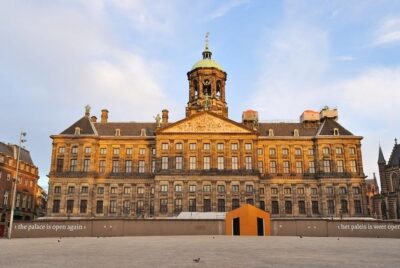
Absolutely Amsterdam – the Essential Introductory Walking Tour
Read our review →

Anne Frank Walking Tour – Guided in EN/DE/IT/ES
Read our review →
Anne Frank Walking Tour Amsterdam Including Jewish Cultural Quarter
Read our review →Browse the lists this tour appears in