
Reviewed · AMSTERDAM WALKING TOURS
Amsterdam: “Operation 45 ” Treasure Hunt Walking Tour
If you like city walking that turns into a game, Operation 45 Treasure Hunt Walking Tour is a great fit. It mixes Amsterdam landmarks with a WWII story about a missing cache of diamonds, and you move through the old Jewish District with physical puzzles instead of staring at a phone. I especially like the way the game uses the city itself, so you’re actually looking up at details as you go.
Two things I really like: first, the backpack with old tins, maps, boxes, and locks makes it feel like an escape room you can walk through. Second, you get a guided-style story moment at several stops, including the Shadow Wall and the Portuguese Synagogue, without the usual tourist-center shuffle. A fair consideration: the route is about 3 km, and while it often lands around 2 hours, it can stretch to 2 to 3 hours depending on how puzzle-focused your group is.
Key things to know before you go
- Physical puzzle gear, not an app: real items, printouts, boxes, and locks.
- Architecture clues: you solve puzzles by noticing details in buildings and streets.
- A WWII diamond-heist storyline: follow a trail tied to the Dutch Resistance.
- Old Jewish District focus: a quieter area than Amsterdam’s busiest lanes.
- Multiple puzzle stops: five locations along a short walking route.
- Prize at the end: everyone who finishes gets something for the win.
Mystery City Games HQ and the WWII diamond story setup
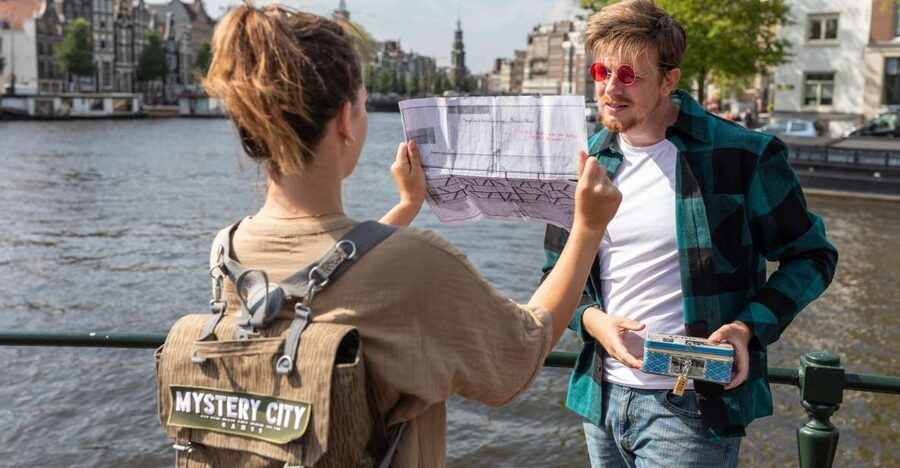
The experience starts at Mystery City Games, on Zwanenburgwal 178. Look for the sign, then step into the role of investigator. Your game master sets the scene: at the beginning of World War II, a cache of diamonds went missing in Amsterdam, and you’re going to follow the Dutch Resistance trail to track down clues.
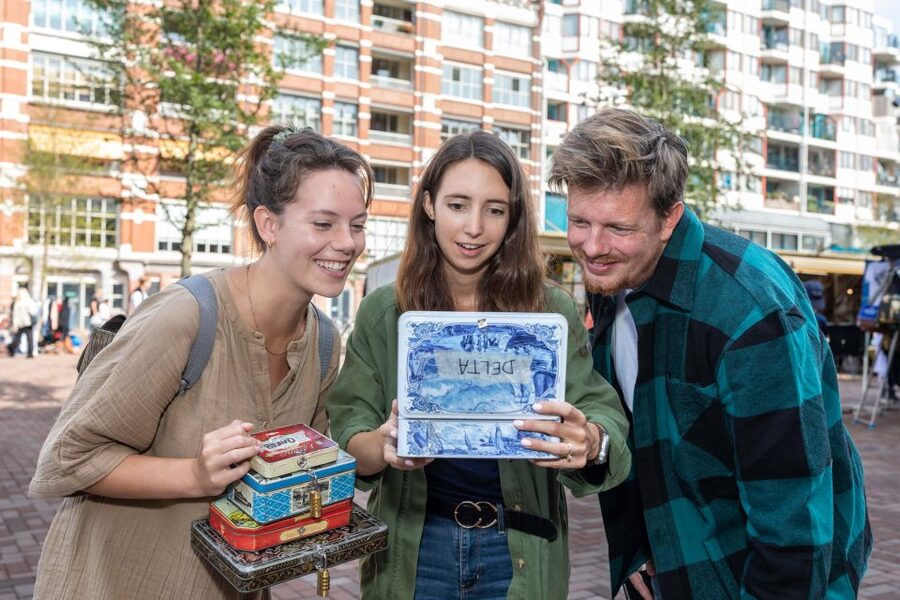
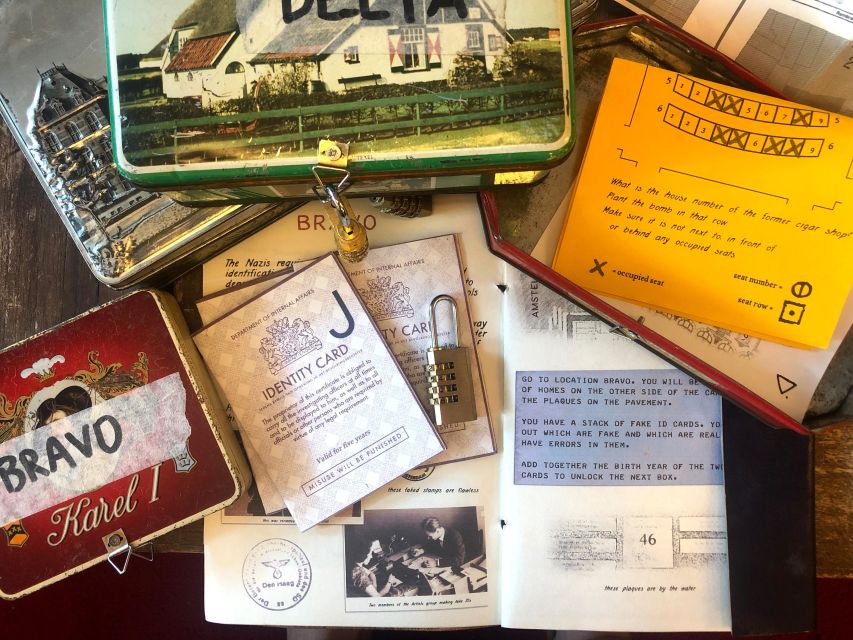
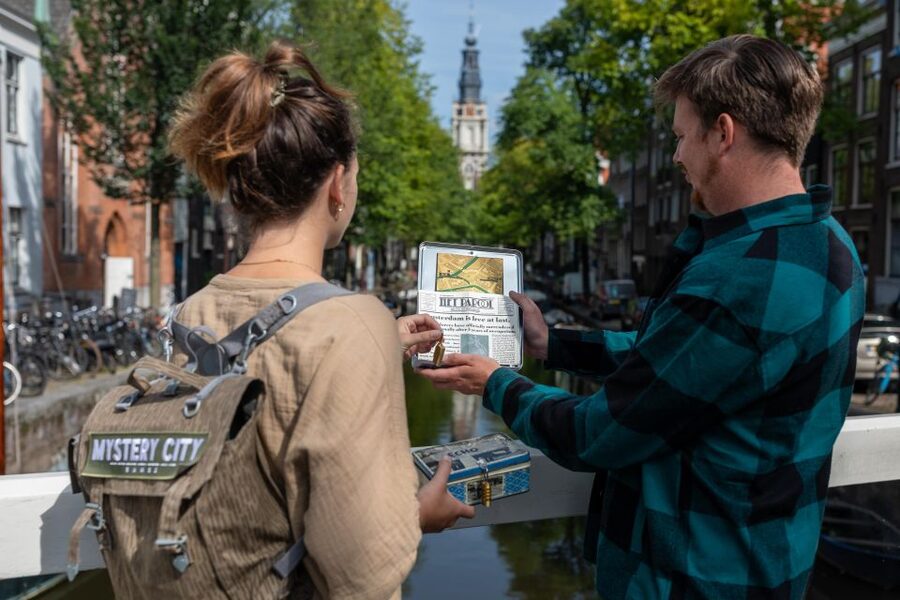
Then you get the backpack. This is not a download, not an app, not a bunch of QR codes. You’re handed physical game tools like old tins, maps, boxes, and locks. That matters more than it sounds. When the puzzles are hands-on, you stop rushing through landmarks like photos ops, and you start actually using your senses. You’ll be reading, comparing, opening things, and combining clues while you walk.
Tip: wear shoes you trust. The tour is short by Amsterdam standards, but it is still a continuous walking puzzle route. The comfortable-shoes note is there for a reason.
More walking tours in Amsterdam:
- Anne Frank’s Story – Guided Walking Tour through Amsterdam
★ 5.0 · 11,619 reviews - Amsterdam: Life of Anne Frank and World War II Walking Tour
★ 4.8 · 10,467 reviews - Absolutely Amsterdam – the Essential Introductory Walking Tour
★ 5.0 · 3,629 reviews
How the 2-hour, 3 km route works in real life
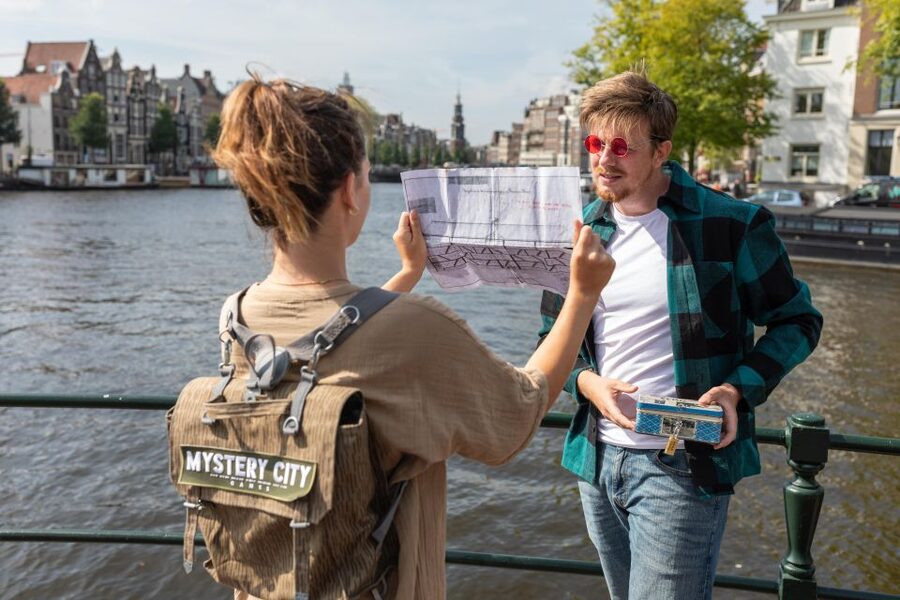
The tour is designed for about 2 hours, with a route length of roughly 3 km. In practice, the pacing depends on your group. If you’re the type who enjoys puzzles and likes to work things out step-by-step, you may come close to the 2-hour mark. If you’re more relaxed or you get stuck on a lock or clue, it can run closer to 2 to 3 hours.
Also, this isn’t the kind of walk where you stop for long photo breaks at every corner. The game keeps you moving, and you’ll be focused on finding what the clues are pointing to. That’s part of the fun, but it’s good to know up front: plan the rest of your day with a little buffer.
One practical mindset shift: don’t treat the stops like separate attractions. Treat them like stations. Your job is to solve the puzzle at each location, then use that momentum to move to the next clue.
Following the Dutch Resistance trail through Amsterdam’s old Jewish District
What makes the route feel special is where it takes you. You’re exploring Amsterdam’s former Jewish District as part of the storyline, so you’re not only seeing famous buildings. You’re also walking through streets that feel lived-in and local, the kind of area you might not plan to explore if you only had time for the most famous canals.
The tour uses five locations within this area. Some are clearly named in the plan you can prepare for, and one additional stop is part of the Resistance trail. Either way, the format stays consistent: arrive at a stop, use items from your backpack plus what you can observe in the architecture, then take one step closer to figuring out where the diamonds went.
This is also where the tour earns its value. A lot of “treasure hunt” products are just a scavenger list. Here, the hunt is built around noticing details, then tying those details back to stories from the WWII resistance. That keeps the puzzles from feeling random.
Shadow Wall: your first real puzzle stop and what to watch for
One of the named locations is the Shadow Wall. This is where you start putting the game tools to work in a very “look closely” way. You’ll solve puzzles by using clues hidden in the surroundings, not by getting hints from a screen.
So what should you watch for? Think of it as a pattern matching exercise. The game expects you to notice how elements of the architecture or nearby marks relate to the clue you’re working on. If you walk past without stopping, you’ll miss what the puzzle is asking for.
Why this stop matters: it sets your pace and your strategy. After Shadow Wall, you’ll have a feel for how the game expects you to work. You’ll know whether your group should split tasks, whether one person should read while others inspect the environment, and how quickly you should check the clue tools in your backpack.
If your group tends to move fast, slow down here. Shadow Wall is the kind of place where your brain needs a second look to connect the physical details to the puzzle logic.
Same city, a different kind of day out:
- Amsterdam Classic Saloon Boat Cruise with Drinks and Cheese
★ 5.0 · 31,825 reviews - Amsterdam Luxury Canal Cruise + Unlimited Drinks & Bites option
★ 5.0 · 30,518 reviews - Amsterdam: Heineken Experience Ticket
★ 4.6 · 30,055 reviews - Amsterdam: Rijksmuseum Entry Ticket
★ 4.7 · 25,535 reviews
Portuguese Synagogue: history you can connect to the buildings
Next up is the Portuguese Synagogue. This is one of those Amsterdam places that already draws attention just standing there, but the hunt makes you do more than admire it. You’ll use architecture cues and the contents of your backpack to solve the next puzzle, while also hearing stories tied to the resistance and the broader WWII timeframe of the mystery.
I like this stop because it teaches you a travel habit you can use anywhere. Instead of treating history like a plaque you read for 20 seconds, you learn to connect the story to shapes, layout, and details in the environment around you.
A small drawback to keep in mind: if your group is allergic to puzzles and would rather just walk and watch, the synagogue stop will feel like part museum moment and part game checkpoint. The good news is the game still includes storytelling, so it’s not just solving lock after lock in silence.
Artis Zoo: the game breaks up the landmarks and keeps you alert
Artis Zoo appears on the route as another named stop. I like that the experience doesn’t stay only on the “great buildings” track. Zoo grounds and the surrounding area give the walk a different texture, and the game uses that change of scenery to keep you alert.
Here, the puzzles keep the same rule: clues are tied to what you can observe, and you’ll be working with physical game components rather than digital prompts. If you’re traveling with kids at the right age or with a mixed group, a stop like this can help the energy level stay high because it feels less like a single formal monument and more like an active place in the city.
Also, remember what you’re doing at each station: you’re trying to progress in the diamond-heist mystery. That means even when the place is visually interesting on its own, you should still take a couple of minutes to scan for puzzle-related cues, rather than fully switching into sightseeing mode.
The diamond factory stop: turning the story into the final step
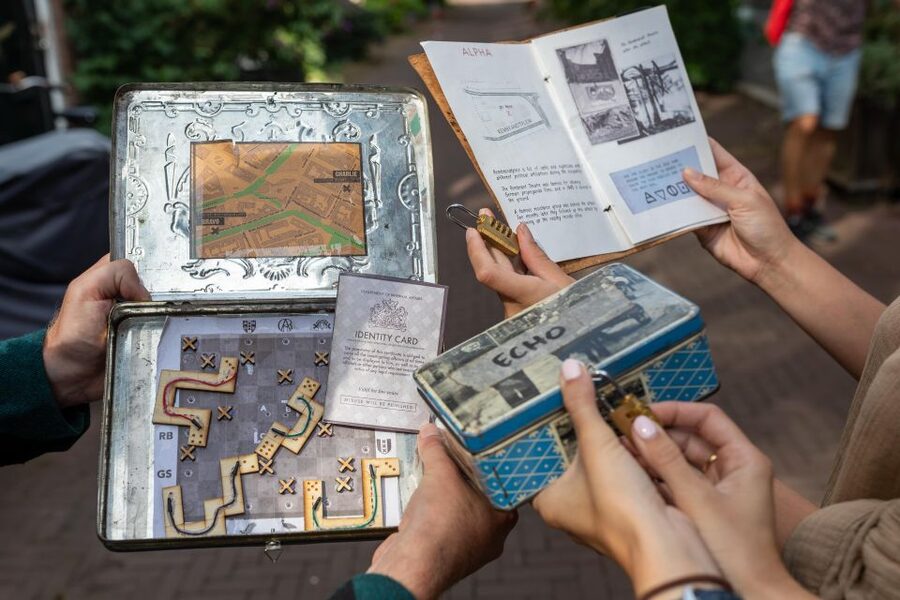
The hunt includes a stop described as a diamond factory. That fits perfectly with the WWII diamond-heist storyline, because it shifts your thinking from “mysterious buildings and clues” to “the mechanics of the missing cache.”
The factory-themed checkpoint is where you likely start feeling the structure of the game tightening. If you were wondering whether the earlier puzzles were building toward something, this is where it feels like everything starts connecting. You’ll keep working through the puzzle tools in your backpack and apply what you’ve learned at prior stops.
And then there’s the end. The experience includes a prize for all participants who finish. That’s more than a cute bonus. It gives your group a shared goal, so you keep the energy up toward the end even if you hit a tricky clue.
What’s included, and why the physical format is worth it
Operation 45 includes a backpack stocked with maps, boxes, and locks, plus a 2-hour puzzle walking route with meeting a game master at the start. The prize at the end is included too.
The physical format is what makes this stand out. App-based hunts can be fine, but they often turn into distraction. When you have items you open and locks you manipulate, you get a slower, more focused kind of attention. You’re not just following a route. You’re processing clues in real time.
It’s also a nice way to break up the usual Amsterdam rhythm. Instead of doing museum plus canal cruise plus food, you get a structured “find and solve” adventure that still includes real places like the Shadow Wall and Portuguese Synagogue.
Price and value: is $29 per person a fair deal?
At $29 per person for a 2-hour, about 3 km walking experience, this lands in a mid-range price zone for Amsterdam activities. The value comes from two places.
First, you’re paying for an experience with physical game components. Those tools are part of the product, and you’re also getting guided storytelling from the game master, not just self-guided wandering.
Second, you’re getting multiple stops that would each cost you time and planning if you built them yourself. You’ll cover named landmarks and neighborhood context in a single package, and the puzzle structure helps you visit places you might otherwise skip.
When it might feel overpriced: if you strongly dislike puzzles or you’re expecting a passive tour where you mainly listen. This is a game first, story second, and you participate throughout. When it feels like a bargain: if you enjoy hands-on challenges, want a different way to see Amsterdam, and like discovering history through environment rather than lectures.
Who should book this treasure hunt (and who should skip it)
This is a good fit for:
- Escape room fans who want a city version of that experience
- People who enjoy puzzle-solving and want a reason to look closely at architecture
- Anyone who likes WWII stories and the Dutch Resistance angle, but wants it tied to specific locations
- Families with kids who are old enough to engage with clues (the tour is not suitable for children under 6)
A possible mismatch:
- People who need lots of seating or long breaks. The route is walking-focused.
- Anyone who struggles with mobility, because even with a wheelchair-accessible note, the tour is still listed as not suitable for people with mobility impairments. If you fall in that category, it’s smart to check carefully before committing.
Based on the experience style, I’d rank it as “active sightseeing.” You’ll get the sights, but you’re also doing something the whole time.
Should you book Operation 45 Treasure Hunt Walking Tour?
I’d book it if you want Amsterdam with a purpose. This isn’t just a checklist of famous stops. It’s a short, doable puzzle walk through the former Jewish District, tied to a WWII diamond-heist story and solved through real physical game gear.
Skip it if your ideal Amsterdam day is mostly effortless and quiet. You’re walking, reading, inspecting, and solving. And if you have mobility limits, double-check fit first because the route is still about 3 km.
If you’re on the fence, consider this simple question: do you enjoy hands-on challenges more than you enjoy passively absorbing facts? If your answer is yes, you’ll likely have a very satisfying couple of hours.
FAQ
Where is the meeting point for Operation 45?
Meet at Mystery City Games, Zwanenburgwal 178, 1011 JH Amsterdam, Netherlands. Look for the Mystery City Games sign.
How long is the tour?
The duration is about 2 hours.
What distance do you walk?
The route is 3 km.
How much does it cost?
It costs $29 per person.
Is the tour run in English?
Yes. The host or greeter is English.
What do you get to use during the treasure hunt?
You receive a backpack with treasure maps, boxes, and locks. The materials are physical, not an app.
What should I bring?
Bring comfortable shoes.
Is it suitable for children?
It is not suitable for children under 6 years old.
Is it wheelchair accessible?
The activity is listed as wheelchair accessible, but it is also listed as not suitable for people with mobility impairments. If you have accessibility needs, it is worth checking carefully.
What is included at the end?
The tour includes a prize for all participants at the end.
Recently reviewed around Amsterdam
- Rotterdam Center: Cocktail Bar Walking Tour – Self Guided★ 2.9 · 9 reviews
- Rent a bike in Amsterdam | 1, 2, 3+ hours★ 4.5 · 68 reviews
- Amsterdam: Rijksmuseum Masterpieces Guided Small Group Tour★ 4.9 · 31 reviews
- Romantic Photoshoot Experience for Couples in Amsterdam★ 4.7 · 25 reviews
- Amsterdam: Queer Nightlife Tour★ 4.8 · 7 reviews
- Amsterdam: Self-guided Red Light District Pub Crawl Mystery★ 3.7 · 6 reviews
- Amsterdam: Red-Light District Pub Crawl and Booze Boat Tour★ 4.1 · 120 reviews
- Amsterdam: Private Red Light District and Food Tour★ 4.8 · 62 reviews
Amsterdam Walking Tours, compared.

Anne Frank’s Story – Guided Walking Tour through Amsterdam
Read our review →
Life of Anne Frank and World War II Walking Tour
Read our review →
Absolutely Amsterdam – the Essential Introductory Walking Tour
Read our review →

Anne Frank Walking Tour – Guided in EN/DE/IT/ES
Read our review →

Anne Frank Walking Tour Amsterdam Including Jewish Cultural Quarter
Read our review →Browse the lists this tour appears in