
Reviewed · AMSTERDAM WALKING TOURS
The Hague: Old City Private Walking Tour
The Hague has a way of feeling extra formal without trying too hard, and this private old city walk leans right into that royal mood. I especially like how the tour pairs the Binnenhof’s 13th-century setting with what the Dutch government does today, and how you get a close look at the royal palaces used in real life, including Noordeinde Palace.
Two other things I liked a lot: the guide connects stories from centuries ago to streets you can still see, and the pace stays relaxed enough that you can ask questions. One possible drawback, especially if you are traveling solo, is the price, since it is $265 per group up to 10, so it is best value when you share with friends or family.
Key points before you go
- Binnenhof focus on the 13th-century complex tied to modern Dutch politics
- Royal palace access without long waiting, thanks to a separate entrance
- Charles V and the Voorhout lime trees story, tied to what you see on the walk
- Dramatic turning points like Van Oldenbarnevelt and the De Witt brothers, explained along the route
- Noordeinde Palace as the present working palace linked to King Willem-Alexander
- Relaxed private format where you can actually talk with your guide
Why this regal 2-hour walk works in The Hague
If you only know The Hague as a stop near Amsterdam or Rotterdam, it can surprise you. It is the seat of the Dutch government and parliament, but it does not feel like a typical capital city. Instead, you get palaces, administrative buildings, and shaded lanes that make politics feel human, almost theatrical.
What makes this tour especially appealing is that it does not treat history like a museum script. You walk through the layers: the city started as a wealthy village, grew into a place of grandeur, and became the center of national decision-making. Your guide ties that evolution to the buildings in front of you.
You also get the advantage of a private format. In a small group, you can ask for clarifications, adjust the pace, or ask what a certain statue, façade, or street name is connected to. That is a big deal in a place like The Hague, where details can feel easy to miss when you are walking on your own.
More trips to The Hague and Scheveningen:
- The Hague: Mauritshuis Entrance Ticket
★ 4.7 · 2,706 reviews - The Hague: City Canal Cruise
★ 4.6 · 2,024 reviews - From Amsterdam: Rotterdam, Delft & The Hague Guided Day Tour
★ 4.2 · 1,765 reviews
Meeting point near Central Station: start easy, stay on time
The tour meets in the hall of The Hague Central Station, in front of Albert Heijn to go. That is practical for two reasons. First, it is easy to find even if you arrive by train at a random time. Second, it means you start your walk near major transport, so it is simple to fit the 2-hour experience into a day of sightseeing.
Because it is a 2-hour private walking tour, you should plan for a light day after or before. Think of this as a high-impact walking block where your guide helps you understand what you are looking at, rather than a long stretch through every neighborhood in town.
If you want to add other stops that afternoon, keep them close by. The point here is concentration: you have a short window to get oriented around the old center, the royal sites, and the government core.
The streets between palaces: what you notice when a guide points the way
One of the tour’s strengths is that it does not just drop you at famous landmarks. It has you walking down shaded avenues and through the areas where royal and city palaces sit side by side with official buildings.
As you walk, your guide explains how The Hague grew from its early role as a hunting residence. Count Floris IV built that hunting residence in 1230, and it is the kind of origin story that suddenly makes the later buildings feel logical rather than random. The Hague did not spring up as a modern capital overnight. It grew, brick by brick, into a place that could host courts, government, and ceremony.
This is also where you start seeing the contrast that makes The Hague interesting. You get regal-looking architecture, but it is paired with working institutions. That blend matters, because it explains why buildings here have a double identity. They can look ceremonial, yet they are also tools for running the country.
The Binnenhof complex: the medieval heart of Dutch government
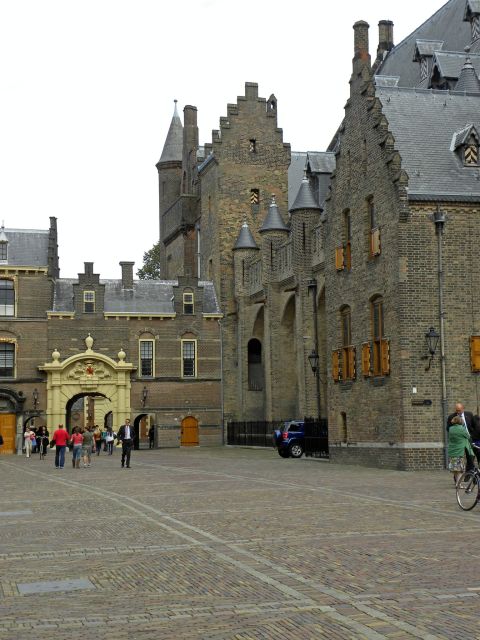
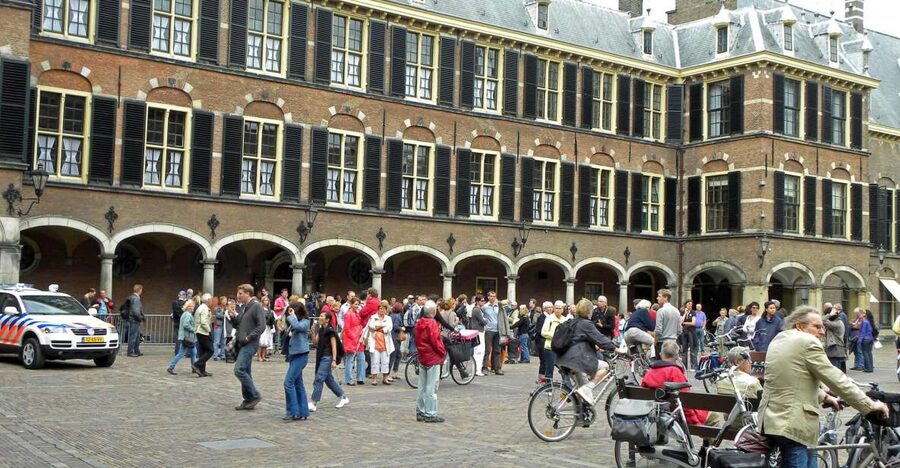
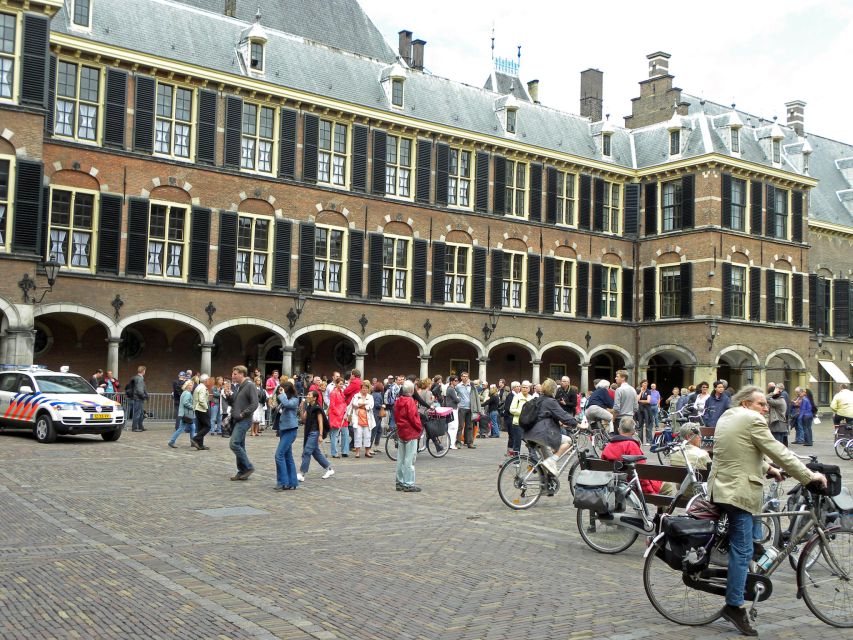
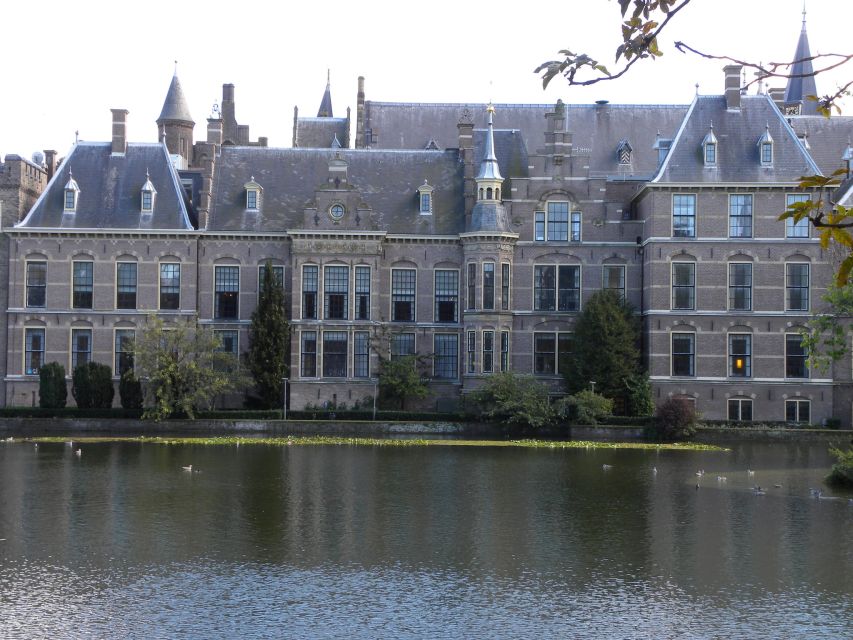
The centerpiece of the walk is the Binnenhof complex, a 13th-century cluster of buildings that has long been tied to Dutch parliament and administration. Even if you have seen photos of The Hague’s political core, seeing it in person hits different. The scale feels “real,” and the layout helps you understand how authority was arranged long before modern offices.
Your guide shows you the historic Houses of Parliament in The Hague as part of this segment. That is a major highlight because it gives context to the building you might otherwise treat like a backdrop. Instead, you understand it as a site with layers, including earlier eras when power was exercised in a different style.
A practical bonus is that you can often avoid long waits. The tour includes skipping the line through a separate entrance, so you are not spending your short 2 hours stuck in queues. For a walking tour, that matters a lot.
What I think you will enjoy most here is how the guide connects medieval architecture to present-day governance. When your guide explains how older structures shaped how politics unfolded, the buildings stop feeling like scenery.
More walking tours in The Hague:
- The Hague: City Walking Tour
★ 4.5 · 156 reviews - The Hague: Courtyard Walking Tour
★ 4.5 · 71 reviews - Anne Frank’s Story – Guided Walking Tour through Amsterdam
★ 5.0 · 11,619 reviews - Amsterdam: Life of Anne Frank and World War II Walking Tour
★ 4.8 · 10,467 reviews
Noordeinde Palace and the feeling of a real working royal site
A big draw of this tour is how it brings you to royal sites that are still active. One of the most specific stops is Noordeinde Palace, described as the working palace for the present King Willem-Alexander.
This is valuable because it changes the tone of what you see. Many royal palace visits elsewhere are entirely about tourism. Here, the message is that the monarchy is not just history behind velvet ropes. It is still part of the current political and cultural system, even if your time inside is limited to what the route and access allow.
You also get a sense of continuity. Your guide walks you past former and current royal palaces along the way, so you are not only looking at one “big attraction.” You are seeing how the royal presence is distributed across the old city fabric.
If you like royal architecture, you will appreciate the structure and setting. If you prefer politics, you will appreciate the way royal and civic functions share space here.
City Hall and De Resident: handsome administration you can actually read
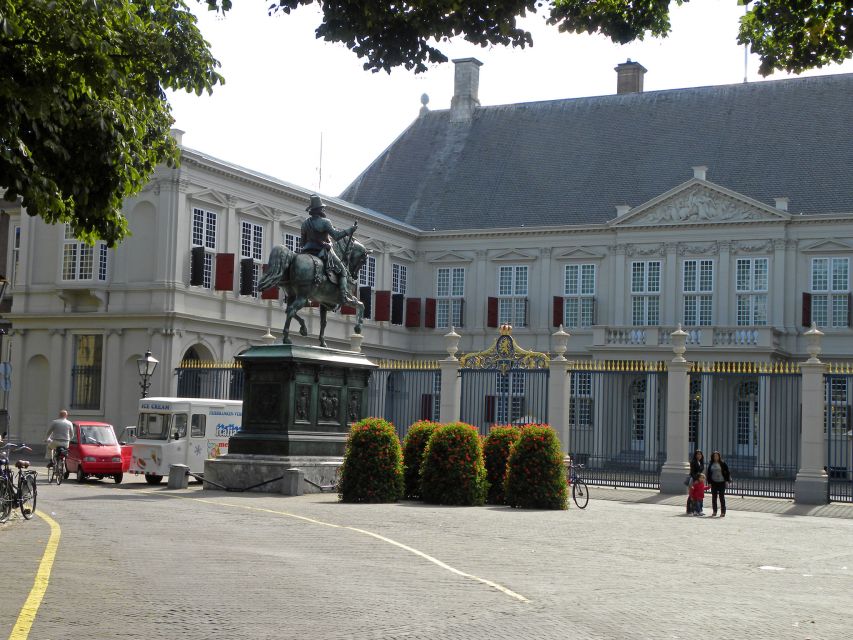
Beyond the royal core and the Binnenhof, the tour also highlights civic landmarks like City Hall and De Resident. These might not be the first thing people Google when planning The Hague, but that is exactly why they work on a guided walk.
A guide helps you notice what your eye might skip. You start recognizing which buildings are designed to impress, which ones signal stability, and which ones feel more functional. In a city where power has always mattered, “administration buildings” are not neutral. They communicate authority.
This segment is especially good if you like architecture but find it hard to interpret alone. Instead of staring at façades with no story, you learn what to pay attention to as you go.
The payoff is subtle but real. After a stop like this, you can look at other official buildings in the Netherlands with a better sense of what they are saying.
The hidden drama you hear on the way: Charles V, lime trees, and political violence
One of the most memorable parts of the walk is the way it uses history as a street-level guide. You hear stories that sound dramatic because they are dramatic: the kinds of events that changed governance, power, and public life.
Your guide shares how Emperor Charles V ordered four rows of lime trees planted in the Voorhout. That detail matters because it is not just trivia. It connects imperial influence to a visible, walkable feature of the city. When you understand where a street planning decision came from, the city feels less random.
Then come the darker, high-stakes stories. You learn about the dramatic decapitation of Van Oldenbarnevelt, and the assassination of the De Witt brothers. The way this is presented makes sense on a walk through government space. These weren’t remote historical moments. They were major threats to political leadership, and this city became the stage for those conflicts.
I like this approach because it turns a 2-hour walking tour into a sequence of causes and effects. You are not just collecting dates. You are understanding why the seat of power hardened, protected itself, and transformed.
How the guide experience feels: relaxed pace, lots of questions
A private tour lives or dies by the guide, and the strong feedback this kind of tour tends to get is about communication. People love that the tour feels relaxed, and that you can ask questions whenever something clicks or confuses you.
In one example, a guide named Bert stood out for sharing lots of information. That is the sweet spot you should look for: not just facts, but explanations that make the city’s political and royal layers easier to hold in your mind.
Also, the tour is offered in English, German, and Dutch, so if you want a specific language for comfort, you have options.
One more practical note: since this is a walking tour, comfort matters. Wear good shoes. The sights are important, but you also want to enjoy the simple pleasure of strolling through the old streets with someone translating them into a story.
Price and value: when $265 per group makes sense
The tour costs $265 per group, up to 10 people, and it runs for 2 hours. On paper, that can sound pricey, especially if you compare it to cheaper group tours. But walking tours are one of those categories where the format changes the equation.
Here is how I look at the value:
- If you have 4 to 6 people in your group, the cost per person becomes far more reasonable, and you get the benefits of privacy, flexible pace, and time for questions.
- You are paying for a focused set of stops that cover royal sites, the Binnenhof core, and civic buildings in a short time window.
- The guide plus the separate entrance that helps you avoid long lines adds time value. In a 2-hour window, saving time is not minor. It is the whole point.
If you are traveling as a solo visitor with no one to share with, you might feel the price more than the content. In that case, consider whether you want a private guide experience specifically, or if you would be happier with a cheaper group option and a bit more patience.
Who should book this private walking tour
This is a good fit if you:
- want royal and political landmarks in one short walk
- enjoy guided storytelling, especially where history links to what you see
- prefer a relaxed pace where you can ask questions without feeling rushed
- are planning a short stop in The Hague and want a smart overview of the old core
It is also a nice choice for small families who want structure, or for friend groups who can share the group price.
If you are the type who loves to wander without any schedule, you might find it less flexible than solo roaming. But the private setup means you can usually adjust within reason, so you still get some control.
Should you book The Hague Old City Private Walking Tour?
I would book it if you want a guided, high-context walk that connects The Hague’s royal sites and government center in just 2 hours. The combination of Binnenhof access, a working royal palace stop at Noordeinde, and the guide’s ability to explain dramatic historical moments makes this more than a checklist tour.
If you are a solo traveler on a tight budget, I would pause and do the math. The price is for a group, up to 10. The experience is best when you spread the cost and fully use the private nature of the tour.
FAQ
FAQ
How long is the The Hague Old City Private Walking Tour?
It lasts 2 hours.
Where do we meet for the tour?
Meet in the hall of The Hague Central Station, in front of Albert Heijn to go.
What is the price for the tour?
The price is $265 per group, up to 10 people.
What is included in the tour?
It includes a 2-hour walk adapted to your wishes, a guide, and VAT.
Are there food or drinks included?
No, food and drinks are not included.
Is the tour available in multiple languages, and is it wheelchair accessible?
Yes. The live guide is available in English, German, and Dutch, and the tour is wheelchair accessible.
Recently reviewed around The Hague
- The Hague: Courtyard Walking Tour★ 4.5 · 71 reviews
- The Hague: Glowgolf Glow in the Dark Indoor Minigolf★ 4.1 · 89 reviews
- From Amsterdam: Rotterdam to The Hague and Delft★ 4.6 · 15 reviews
- From Amsterdam: Rotterdam, The Hague & Delft Private Tour★ 4.6 · 7 reviews
- From Amsterdam: Day Tour to Rotterdam, Delft and The Hague★ 4.8 · 98 reviews
- Private half-day Delft and The Hague tour★ 5.0 · 3 reviews
- The Hague: City Walking Tour★ 4.5 · 156 reviews
- Amsterdam: Zaanse Schans, The Hague & Rotterdam Tour★ 4.8 · 33 reviews
Amsterdam Walking Tours, compared.

Anne Frank’s Story – Guided Walking Tour through Amsterdam
Read our review →
Life of Anne Frank and World War II Walking Tour
Read our review →
Absolutely Amsterdam – the Essential Introductory Walking Tour
Read our review →

Anne Frank Walking Tour – Guided in EN/DE/IT/ES
Read our review →

Anne Frank Walking Tour Amsterdam Including Jewish Cultural Quarter
Read our review →Browse the lists this tour appears in